On June 7 we met with economist Gladys Hernández to talk about the Cuban economic situation and the effects on the Cuban economy by the US trade embargo. One of the first things that Mrs. Hernandez said to us was that Cuba and the US do have a relationship, but it is a love hate relationship. The effects on Cuba from the United States and vice versa go way back from when The US won Cuba from Spain as a spoil of the Spanish-American War. Nowadays many Cubans jokingly say that the second largest city in Cuba and almost every Cuban we met has some sort of relative in the United States. Because of such a large populations of Cubans living in the US remittances are big businesses making up about 2% of Cuba’s GDP. Many Cubans live off of the money they receive from relatives in the US. Cuba also had close relations to other socialist countries during the time after the revolution up to the ending of the eastern European socialist block. There was a time when Cuba received 98% of its oil, 75% of its food and 80% of its spare parts from the socialist block. Obviously once the Soviet Union ended in 1991 this affected Cuba greatly when these things no longer came to the island, between the years of 1991 and 1994 the Cuban economy decreased by 40% because of the lack of materials. During this time as well there was a large increase of Cubans crossing the Florida straits by any means necessary to get to the United States for a better life. During this time the Cuban government decided that instead of changing from the socialist model they would focus on areas such as Sugar production, Agriculture, Mining, Fishing and Biotechnology. Biotechnology being the most interesting and productive and in 2006 this sector had a 11% growth. Learning more about the complexities of the Cuban economic system and its relation to the United States was very interesting and really made our time there so much more impactful.
Thursday, June 30, 2011

Wednesday, June 29, 2011
US Interests Section

The problem with breaking off diplomatic relations is that it eliminates the possibility of future communication should the need arise, as well as diminishing the leverage both sides hold on each other. The US prefaces most of its demands on Cuba with the promise of easing the embargo upon successful completion of the task, even though previous overtures by Cuban governments have resulted in little economic or political opening. The US continues to trade with China and Vietnam, which have similar human/civil rights issues as Cuba, and the explanation for why this is not hypocritical was interesting but unfortunately we are not at liberty to discuss it.
Tuesday, June 28, 2011
Okantomi & Afro Cuban Dance

With infectious beats, eclectic voices and hard steps, Okantomi communicated with deities from the Yoruba religion and told stories of a man selling fruit and a woman washing clothes. The show represented many music genres made popular by Afro-Cuban artists such as Son and Cha Cha Cha. As a dancer myself I enjoy witnessing many genres of dance. At one point during the show, Okantomi requested the hand of the students and taught us dance moves. Since the reemerging, Afro-Cuban people have been able to retain their art-forms and represent it to the world with Afro Cuban artists. Okantomi has traveled all over Cuba and has even performed in the United States.
Alfredo Prieto : Cuba in the 21st century

On Thursday June 9th we had a two hour discussion with Alfredo Prieto, a Cuban intellectual who had written extensively about the history of US-Cuban relations and had travelled widely within both the United States and Cuba.
To begin his talk, he explained that the relationship between the United States and Cuba had always been defined by asymmetry, contrary to a dominant US perception that a positive bilateral relationship had existed between the two countries. He explained the deep historical connections between the US and Cuba, that women from Havana sent George Washington money during the American Revolution, and that John Quincy Adams came up with the desire of Cuba's rapid transition from Spanish to American hands. He went on to explain the 20th century history of the unequal relationship, from the platt amendment, to the CIA's rapid response to the Cuban Revolution with the failed Bay of Pigs invasion.
Most of this we already knew, so it was more relative to us when he began to elaborate on the current state of relations. He pointed out, with more than a touch of irony, that Cubans were even more up to date on American culture than Americans, given that pirated American movies and music arrived in Cuba before they were released in the United States. He acknowledged all the complexities of the embargo, citing the common understanding in Cuba that the continued US support for the embargo lay with the old generation of Cuban-Americans in Miami that had fled when the Castros took power.
We discussed the current thorns in the side of the bilateral relationship, like the Cuban 5, Cuban-American terrorists, and Alan Gross. He said that Alan Gross would most likely be freed one day, and that his detention was primarily a warning to the US not to try any more covert actions in Cuba.
Finally, he discussed his partnership with the Hampshire College in Cuba program, which was very interesting to me as I had a friend from Philadelphia who had participated in that program just a couple of months ago. It turned out we both knew her, which was pretty cool, and made me think again about just how connected the US and Cuba are, despite 50 years of officially existing in mutually exclusive isolation. Mr. Prieto brought an independent viewpoint to our studies in Cuba that underlined continuing difficulties in the governments of both countries, and really furthered our knowledge of the Cuban situation en actualidad. My thanks to both Alfredo Prieto, and the CGE in Cuba program.
Daniel Rosenfeld
Oberlin College '12
Friday, June 24, 2011
Health Care in Cuba

On June 8th, we visited the Brothers Ameijeiras Hospital, which you might recognize as the Cuban hospital featured in Michael Moore’s Sicko. Though the building was originally meant to house the national bank, the newly-victorious Revolutionary government altered construction plans, as Batista and his officials had stolen all the money from the treasury before fleeing to Miami. In 1982, the hospital officially opened. In the lobby, you can see photos of three of the five Ameijeiras brothers for whom the hospital was named. All five brothers played an important role in the uprising against Batista. According to Fidel’s hospital inauguration speech, one brother died in the attack on the Moncada Barracks, a second was murdered on his way to join the rebel forces in the Sierra Maestra, and a third was killed in Havana during an ambush by Batista’s forces. Of the two remaining brothers, one was imprisoned by the regime and the other was one of the 12 men who survived the Granma landing and went on to form the rebel army in the Sierra Maestra.
In Cuba, medicine is strongly linked to the values and images of the Revolution. Apart from the literacy campaign and reform of the education system, medicine was one of the areas on which the Revolutionary government focused most strongly. Cuba now has a fully subsidized medical system, meaning that all care is free (including abortion and plastic surgery). Cuban medical schools provide training, housing, and supplies free of charge to Cuban and low-income students from all over the world, including the United States. Though a developing country economically, Cuba now rivals developed countries in terms of infant mortality and maternal death rates, and the most common causes of death on the island are the same as in the US – the so called “developed-world pandemics” of heart disease, cancer, and diabetes. Cuban doctors travel around the world to assist in times of emergency or as long-term help through bilateral agreements, for example the Cuba-Venezuela pact in which Cuba exports doctors and imports subsidized oil. The US government rejected a Cuban offer to send doctors to Louisiana in the aftermath of Katrina, claiming it was part of a pro-Castro propaganda campaign.
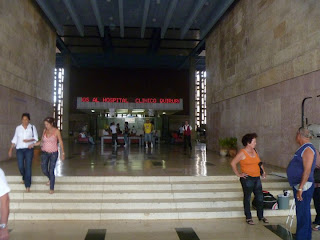 Despite the achievements of the Cuban health system, it still faces problems in maintaining a high level of care. Cuba cannot purchase equipment from the United States or from international companies in which the US investors have a financial stake, making the acquisition of adequate instruments difficult in this age of globalization. Though food and medical products are supposedly excepted from the embargo on trade with Cuba, a complicated licensing process is necessary for each purchase, essentially invalidating the exception. Cuba then either has to import medicines and equipment from China, Venezuela, or Europe, or import raw materials and produce its own.
Though the Cuban healthcare system clearly faces problems, such as varying hospital quality and long waits for non-urgent care, it seems to have succeeding in overcoming many of the failures of the US system. People do not go broke trying to pay for medical care. Compare that to this recent news story from North Carolina, about an unemployed man who robbed a bank of one dollar in order to secure a jail sentence that would guarantee him some level of health care.
Marina Gonzalez
Thursday, June 23, 2011
People to People Literacy

On Wednesday June 8, we visited El Museo de la Campaña de Alfabetización (the literacy campaign museum). At the museum we learned about the literacy campaign that began on January 1, 1961 and ended on December 22, 1961 and that eradicated illiteracy and made Cuba, as the museum claims, “the first country in the Americas to be free of illiteracy.”
For the campaign, tens of thousands of students volunteered to leave their home for a year to go into the more rural areas of Cuba and teach many of the inhabitants there how to read and write. These students were given training before along with some educational materials. Many teachers and workers also volunteered for the campaign; however, many of these volunteers were often sent into the more dangerous urban areas that needed teachers.
From the museum, one idea especially sticks out in my mind. Our tour guide kept talking about the thousands of students who volunteered and walking around the museum their faces were everywhere. However, also in the museum were the faces and letters from those people who were being taught during the literacy campaign. Walking around it was impossible not to see the real connections being formed

between people from all different backgrounds through a campaign that encompassed the entire country. Besides eradicating illiteracy in the country, it is said that the campaign helped to lessen racism in the
country as well as to lessen rural versus urban sentiments.
Learning about the effects of the campaign while making my own connections with new people in Cuba, I felt that power of meeting new people and trying to walk with them in their life for a little while. I do not know what I will do after studying abroad, but I know that whatever I do in my life, the one thing that will always stick out in my mind will be the people that I have met in my travels. Like the students of the literacy campaign, I want to affect some sort of change either in my country or in this world and I would preferably like to work for education reform. I do not know how I will go about this, but whatever I do I will never forget that the people that I work with will always be more important than any work I ever do.
Linda McSorley
Fordham University 12'
Monday, June 20, 2011
From Military Bases Into Schools
 Cuba were converted into schools. This conversion reflects one of the main tenets of the Cuban revolution, which was to provide free, universal education for all Cubans. In Cuba, free education includes not only primary school, high school, university, and graduate school, but also special education, technical school, college for adults who want it and enrollment in a music conservatory.
 classroom, there was written the date and the number of years since the triumph of the Cuban revolution. How is Che Guevarra portrayed in Cuban history? Fidel Castro? If these men were included in U.S. textbooks, I am sure they would be portrayed differently than they are in Cuban textbooks. What does that say about education and textbooks in general? Surely, Howard Zinn has shown us that history may be written by the winners, but that there are many other voices from each moment in history. Does the Cuban education system ignore these voices? What about the U.S. education system? What voices are left out from the textbooks that future generations will never hear?