CGE is now The Center for Global Education and Experience (CGEE)!
These blogs were discontinued, but we continue to blog about our programs at: http://www.augsburg.edu/global/blog/.
Friday, November 15, 2013

Tuesday, October 15, 2013
The Literacy Campaign
Over and over, during our time in Cuba, our group was reminded of the things that the revolutionary government gave to the people in its first years in power. Of course, these things were mentioned in our History class, but we were often surprised at how often they came up at home around the dinner table or in a casual conversation with Cuban friends. One of the most drastic and lasting gifts given to Cubans was the ability to read. Below, Claire (one of our students last semester) reflects on our group's trip to the Literacy Museum.
I must have been around five-years-old at the time. Suddenly signs
actually were words, not just shapes. Exxon wasn’t just a design, it was
a word made up of letters that I recognized. It was probably about as
exciting for me as whistling for the first time—and I was really excited
about whistling for the first time. Neither scene jumps out at me as a
specific time in my life, I know I was young, but I don’t know which car
I was in, or where I lived at the time.
The point is, I don’t remember learning to read. I remember when things started to make more sense, and making the connection that signs were made up of words just like books were made up of words. However there isn’t a time when I remember not reading.
Take a minute to think about your education. How is it that you can read and comprehend this? The letters form words, which form sentences, which form paragraphs, which express thoughts, and all of this is intelligible to you. This isn’t just an image of lines on a screen. For most of you literacy has been a part of your life since childhood. But what if it hadn’t? Or, even more, what if as a child you had the responsibility of sharing literacy with complete strangers?
Cuba sponsored a massive literacy campaign in 1961. In a four-hour speech Fidel Castro declared to the United Nations that Cuba would eliminate illiteracy within a year. Not only were these remarks unheard of in his time—or even today, for that matter—but also he lived up to them.
The literacy campaign in Cuba was one of the largest, fastest, and most
successful there’s been. The teachers were mostly students, although
there were professional teachers, retirees, and various other
volunteers, and over half of them were women. Children as young as
eight-years-old left home to go live in rural areas, where they lived
with strangers for months, teaching them to read and write. Over 100,000
people volunteered to teach. Within the year approximately 707,000
Cubans were taught to read and write, and Cuba reduced its illiterate
population to 0.2%, the lowest in the world. Furthermore, the literacy
campaign didn’t just teach people to read and leave them out to dry;
schools were established for the newly literate citizens to continue
their studies. There were risks involved too. Counter-revolutionaries
murdered some of the volunteer teachers as well as some of the people
living in the countryside who were being taught. The Bay of Pigs
invasion occurred right as the program was starting. And yet, despite
the turmoil that was greatly affecting the country, thousands upon
thousands of children and teenagers asked for, and received, their
parents’ permission to go take part in the campaign as teachers and
eradicate illiteracy.
As someone who is working on a second language I can’t even begin to
imagine not having been able to read until now, or until I was even
older. There are parts of life that I take for granted, and I know that,
but reading is one that doesn’t normally jump out at me. As a baby I
was read to constantly, I learned how to write my (very long) name at a
young age, and there have always been opportunities for me to read and
write. My basement is lined with bookshelves. I read The Jungle by Upton
Sinclair because I thought it would be fun. Because of all of this
being faced with the reality of widespread illiteracy and seeing how it
was handled by a national effort is truly moving. For many who took part
as teachers it is the proudest accomplishment of their lives and
discussing it brings them to tears fifty years later.
It’s easy to forget to power of language—especially written language—and how much simple acts like reading and writing can change a person’s life.
-Claire Wellbeloved-Stone, Connecticut College '14
The point is, I don’t remember learning to read. I remember when things started to make more sense, and making the connection that signs were made up of words just like books were made up of words. However there isn’t a time when I remember not reading.
Take a minute to think about your education. How is it that you can read and comprehend this? The letters form words, which form sentences, which form paragraphs, which express thoughts, and all of this is intelligible to you. This isn’t just an image of lines on a screen. For most of you literacy has been a part of your life since childhood. But what if it hadn’t? Or, even more, what if as a child you had the responsibility of sharing literacy with complete strangers?
Cuba sponsored a massive literacy campaign in 1961. In a four-hour speech Fidel Castro declared to the United Nations that Cuba would eliminate illiteracy within a year. Not only were these remarks unheard of in his time—or even today, for that matter—but also he lived up to them.
 |
| posters celebrating the anniversaries of the literacy campaign |
 |
| flags that were used during the campaign to declare 'territories free of illiteracy' |
It’s easy to forget to power of language—especially written language—and how much simple acts like reading and writing can change a person’s life.
-Claire Wellbeloved-Stone, Connecticut College '14
Friday, October 11, 2013
Academic Director visits Cuba program and sends an update
CGE's Academic Director, Dr. Ann Lutterman-Aguilar, recently visited the History, Culture and Politics of Cuba program. She is happy to report that the students were overall very positive about the first third of the program. A few minor adjustments were made to readings and class time/format after the students provided constructive feedback.
Homestays are going wonderfully and students are looking forward to upcoming out-of-Havana trips.
.JPG)
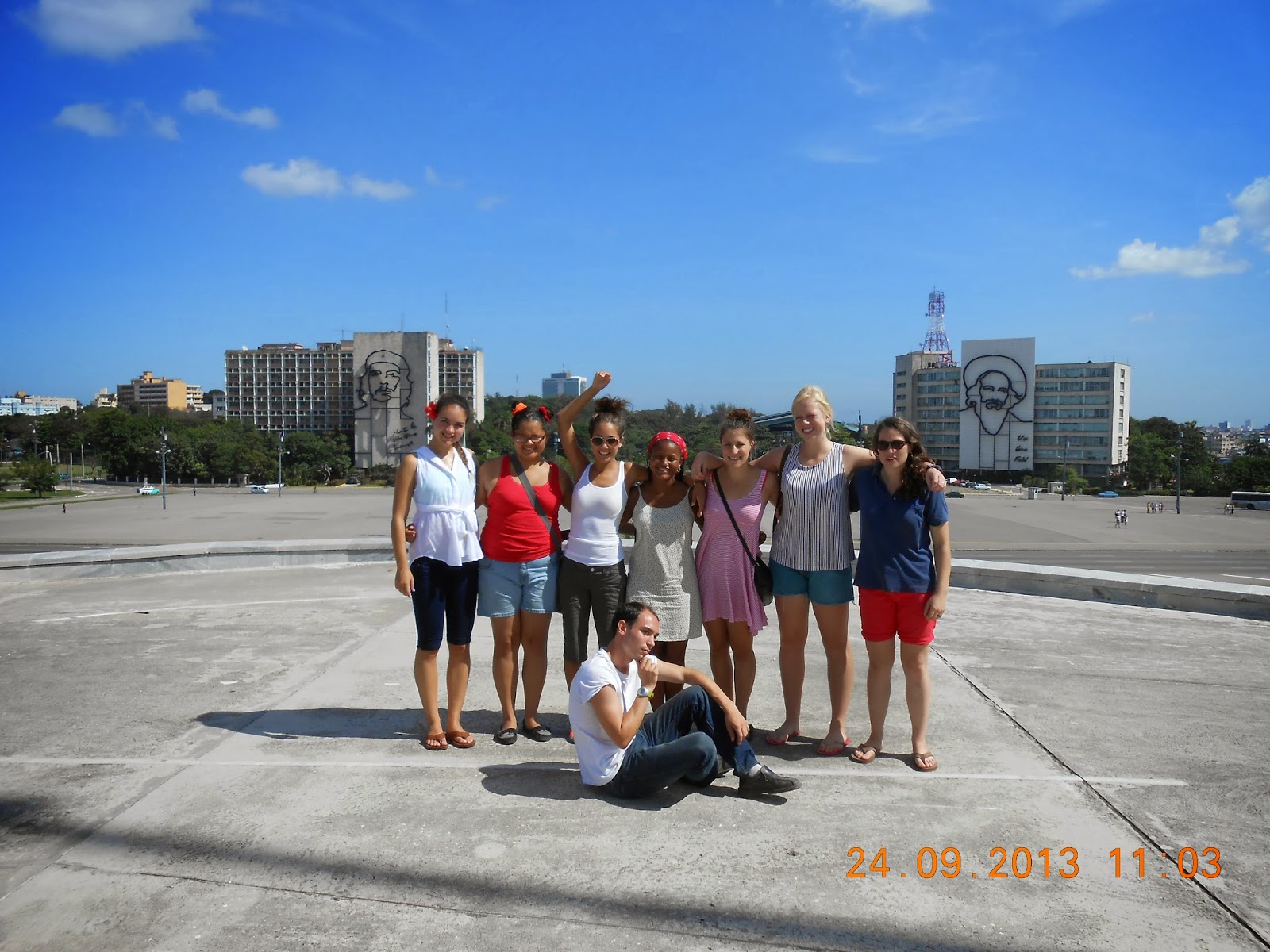
Ann was able to attend the Pedagogic Institute exchange with the CGE students (above), which will be a regular program activity. CGE students were already able to chat with the Cuban students about various topics that are coming up in classes.
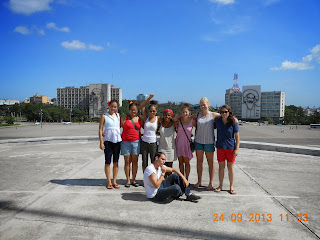
Homestays are going wonderfully and students are looking forward to upcoming out-of-Havana trips.
.JPG)
Ann was able to attend the Pedagogic Institute exchange with the CGE students (above), which will be a regular program activity. CGE students were already able to chat with the Cuban students about various topics that are coming up in classes.
Tuesday, September 24, 2013
Semester Abroad: History, Culture, and Politics of Cuba - Brief Update
Ah, the internet in Cuba. It is both a blessing and a curse. Those of us who have traveled there often welcome the break from modern technology, relish in the quiet, and feel released from the obligation of constant communication. Yet, here in Minneapolis, we are so anxious to hear exciting updates about our semester study abroad program in Cuba. We have been in touch with our staff by phone - everyone is doing well! - but since communication is so difficult, our staff is unable to post to this blog very frequently.
What we can tell you so far:
- We welcomed students from American University, Carleton College, Colorado College, Connecticut College, Fordham University, Gustavus Adolphus College, Point Loma Nazarene University, and the College of Wooster.
- This year, CGE-Mexico program coordinator, Lisanne Morgan, who has extensive experience leading groups in Cuba for CGE, is accompanying the students throughout the semester. She'll be working closely with the Martin Luther King, Jr. Center staff (translator, etc.) and various faculty to ensure a cohesive program. We are so grateful that Lisanne - who brought her partner and son along for the semester in Cuba - saw such value in the program and had a strong desire to ensure its continued success.
- The students had a very intensive and helpful orientation. Last year's students told us they felt there wasn't enough time spent on acclimation to the community and country, so we took that seriously and set aside an extended period of time to do so this year.
- The students are settled in with their homestay families in the Marianao community
We're hoping to get on the phone with Lisanne soon to hear some fun goings-on and will try to post what she shares with us.
Thursday, March 21, 2013
Cuba Semester Program Abroad: Another Update
The semester program in Cuba has been full of activity per usual. The recent death of Hugo Chavez provided a very unique context for learning and students were able to visit Revolution Park to observe the official mourning of his death.
The program has also made official visits to the University of Havana and the Latin American Medical School to learn firsthand about higher education in Cuba. Students have also enjoyed coordinated exchanges with Cuban students (those studying English) at the Pedagogical Institute in Havana.
Students are traveling this week in Cienfuegos and Santa Clara for spring break.
 ^^At a traditional Cuban "peso" market - learning about currencies, buying power, and other everyday economic realities.
 ^^At the University of Havana.
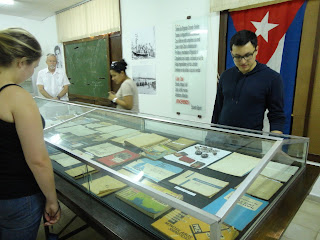 ^^Literacy Museum.
 ^^Havana street scene.
The program has also made official visits to the University of Havana and the Latin American Medical School to learn firsthand about higher education in Cuba. Students have also enjoyed coordinated exchanges with Cuban students (those studying English) at the Pedagogical Institute in Havana.
Students are traveling this week in Cienfuegos and Santa Clara for spring break.


Friday, March 1, 2013
Feria del Libro y mucho mas!
As a mid-week treat last week, we got to attend the Annual International Book Fair here in Havana. I think we all went into the experience without knowing what to expect and were wonderfully overwhelmed by the gorgeous setting, myriad of book vendors, musical acts, food stand, and generally beautiful (albeit it hot and sunny) place to spend the afternoon.
This trip came in the middle of an extremely full week of programming including a visit to the Literacy Museum, a tour of the University here in Havana, a night out dancing, all of our regular classes, our weekly evening of Cuban cinema and a weekend trip to the beaches of Varadero. Needless to say, we all slept soundly last night!
--Rebekah Menning, International Resident Advisor, CGE in Cuba
This trip came in the middle of an extremely full week of programming including a visit to the Literacy Museum, a tour of the University here in Havana, a night out dancing, all of our regular classes, our weekly evening of Cuban cinema and a weekend trip to the beaches of Varadero. Needless to say, we all slept soundly last night!
--Rebekah Menning, International Resident Advisor, CGE in Cuba
Friday, February 8, 2013
Cuba semester program is off the ground!
The Center for Global Education's newest semester program - History, Culture, and Politics of Cuba - is up and running! Students arrive in Havana last week. Rebekah Menning, former staff with CGE-Central America, is serving as the resident advisor for this program. She'll be passing along blog posts as she is able (for those of you who have been to Cuba, you know the internet is not exactly reliable).
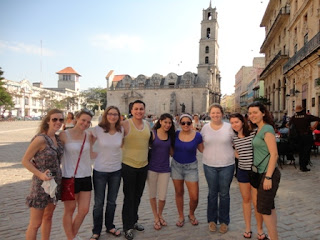
Here are Rebekah's first thoughts...
Greetings from Cuba!
The group is in the midst of orientation week and getting settled into
class routines and our neighborhood of Marianao.
On Monday we all met at the Miami airport and, after taking a quick
charter flight to Havana, our group was greeted at the Martin Luther
King Memorial Center by their staff and our homestay families! Student
and staff alike have been overwhelmed with the generosity of our
reception by host families and the entire staff at the MLK Center.
Yesterday students received a history lecture from the first guest
speaker of the semester and we headed to ‘Habana Vieja’ for a walking
tour of the oldest part of the city. Today is another full day with
students’ first full Spanish class and a visit to a Transformation
Workshop in a nearby neighborhood.
Apart from programming, it’s clear that students are soaking up the
sun, enjoying the cuisine and looking forward to free time on the
weekends to explore and have more time with their host families.
In general we’re excited for all the next three months will bring!
We’ll write here as often as we can to send brief updates about
what we’re up to and hope you’ll check back in occasionally.
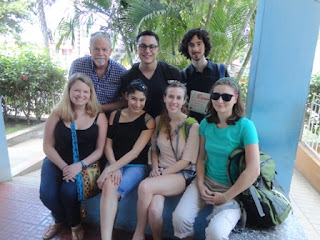
Here are Rebekah's first thoughts...
Greetings from Cuba!
The group is in the midst of orientation week and getting settled into
class routines and our neighborhood of Marianao.
On Monday we all met at the Miami airport and, after taking a quick
charter flight to Havana, our group was greeted at the Martin Luther
King Memorial Center by their staff and our homestay families! Student
and staff alike have been overwhelmed with the generosity of our
reception by host families and the entire staff at the MLK Center.
Yesterday students received a history lecture from the first guest
speaker of the semester and we headed to ‘Habana Vieja’ for a walking
tour of the oldest part of the city. Today is another full day with
students’ first full Spanish class and a visit to a Transformation
Workshop in a nearby neighborhood.
Apart from programming, it’s clear that students are soaking up the
sun, enjoying the cuisine and looking forward to free time on the
weekends to explore and have more time with their host families.
In general we’re excited for all the next three months will bring!
We’ll write here as often as we can to send brief updates about
what we’re up to and hope you’ll check back in occasionally.


Subscribe to:
Posts (Atom)